Why discs struggle to heal
The discs between your vertebrae are squeezed and twisted all day. Even when you’re resting, they stay under pressure, so a damaged disc rarely gets the chance to heal on its own.
As a disc wears down, its gel-like centre loses water and the disc gets thinner. The tougher outer layer can become brittle and crack, which can lead to a bulge or herniation. When that presses on a nerve it can cause severe pain that runs down the leg or into the arm.
How decompression helps
Decompression gently stretches the spine to lower the pressure inside a damaged disc. That draws water and nutrients back into the disc to support healing, and can help ease a herniated disc away from the nerve it’s pressing on.
Who it can help
- bulging and herniated discs in the neck or low back
- sciatica and pain that radiates down the leg
- numbness in the arms
- spinal stenosis
- Degenerative Disc Disease
- osteoarthritis
- some people whose back surgery didn’t resolve their pain
Why SpineMED
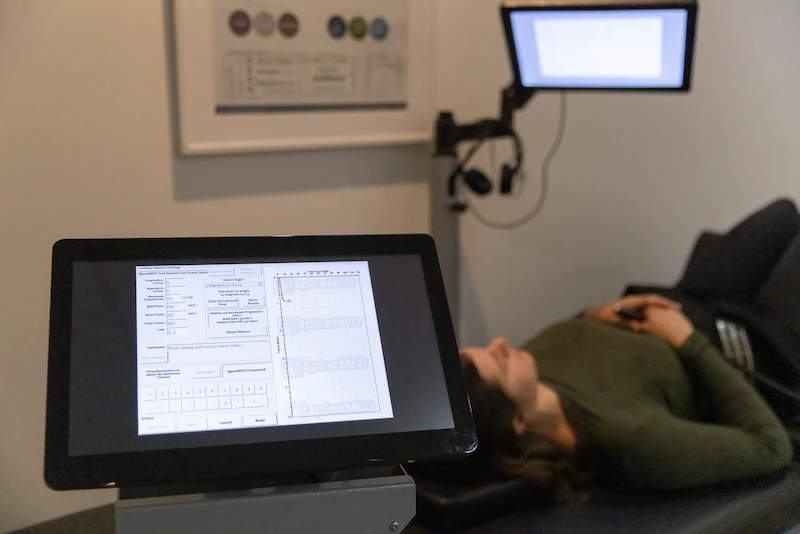
SpineMED is a newer generation of decompression table, designed to fix the problems with older traction devices.
Lower force, more comfort
SpineMED holds the pelvis directly instead of using harnesses, so it needs much less force. A typical session for a 200 lb patient uses about 60 lb of force, compared with over 110 lb on older machines.
Targets the right disc
The table tilts the pelvis (0–25°) for low back sessions and positions the head (0–30°) for neck sessions, so treatment can focus on the specific disc that’s causing trouble.
Works with your muscles, not against them
Muscles naturally tighten when the spine is pulled. SpineMED checks tension every 2.5 milliseconds and adjusts within 20 milliseconds, so it can decompress the spine without triggering spasms.
The same every session
The pelvic restraint fits patients from about 70 to 500 lb and positions you the same way every time, so each session builds on the last.
When it isn’t suitable
Dr. Heather will assess you first to make sure decompression is safe for you. It isn’t used for people with:
- an unstable spine, such as a recent fracture
- pars defects on both sides, or unstable spondylolisthesis (usually grade 2 and above)
- severe osteoporosis
- cancer or tumours of the spine
- surgical hardware in the area being treated
- patients under 15
Having had back surgery doesn’t rule you out unless there’s hardware where we’d be treating.